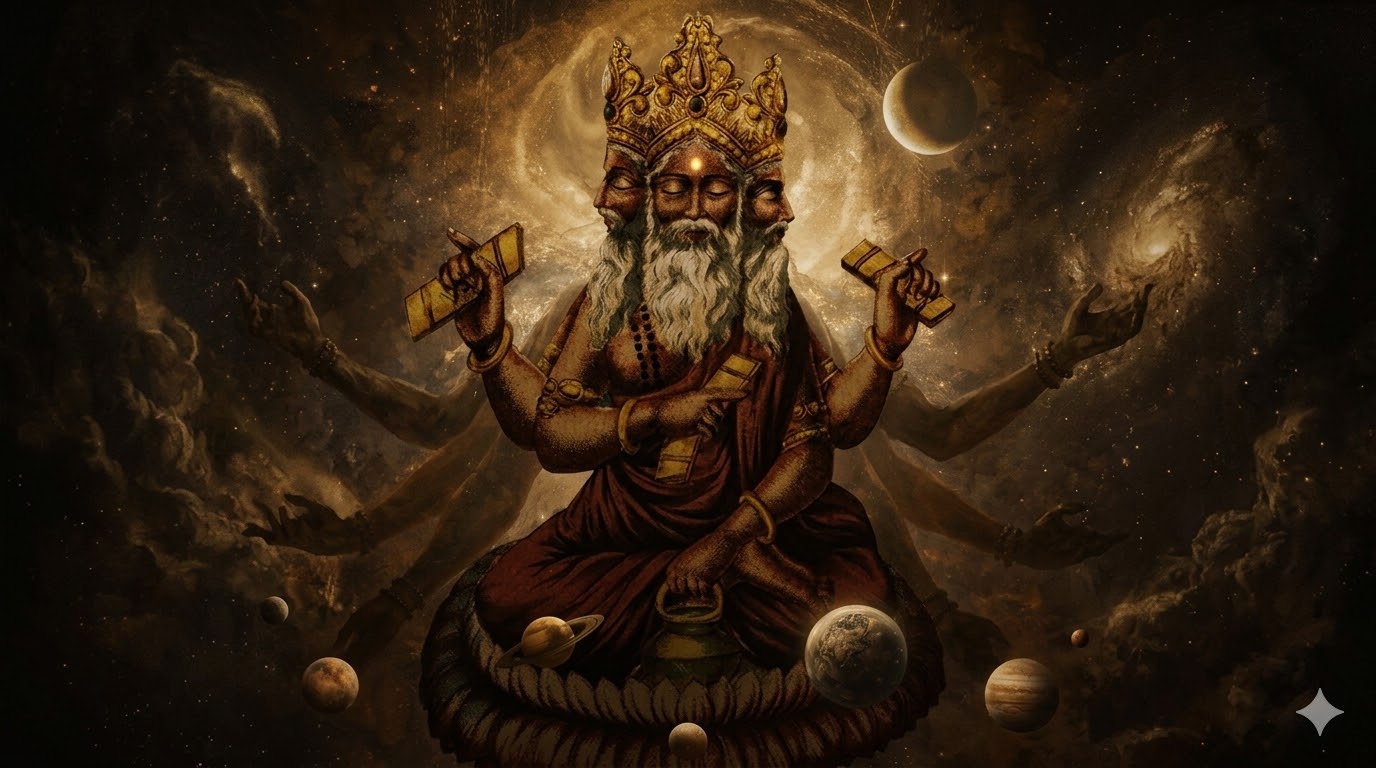
If you have spent any time online discussing Hindu scriptures, you have almost certainly run into some version of this line: “The Manusmriti is an oppressive book that targets women and lower castes.”
It is one of the most repeated criticisms of Sanatan Dharma, and yet, the overwhelming majority of people repeating it have never opened the text. Their opinions are built on cherry-picked verses pulled from propaganda blogs, stripped of every shred of context, and passed around as settled fact.
This essay is my attempt to do the opposite. Over the next half an hour, we will look at where the Manusmriti sits in the larger Hindu library, how we got the text, how it evolved through commentators, what it actually says about women and Varna, what it gets genuinely wrong, and how a regional Dharmashastra ended up being treated as the universal lawbook of Hinduism. The aim is not to defend every verse. Some of them are indefensible by any modern standard, and I will try to say so plainly.
Basically, the aim is to give you enough context to think for yourself.
The scholarly spine of my research rests on the work of P.V. Kane (History of Dharmaśāstra, especially Volume II, 1941), Ganganath Jha’s translation of Medhatithi’s Manubhashya (1920), Patrick Olivelle’s critical edition of the Mānava Dharmaśāstra (Oxford, 2005), the commentaries of Kulluka Bhatta and Narayana, and the more recent work of Nithin Shridhar (Chatuh Sloki Manusmriti, 2025) and podcast clips of Sanskrit scholars like Nityananda Mishra Ji.
All my Research Notes, Source Links and documentation can be found here.
- Part 1: Where the Manusmriti Sits in the Hindu Library
- Part 2: How We Got the Manusmriti
- Part 3: How the Text Evolved, and How It Became a Controversy
- Part 4: What the Manusmriti Actually Says About Women
- Part 5: The Question of Marriage Age
- Part 6: On the Roles of Women, Without Sugar-Coating
- Part 7: Decoding Varṇa, Jāti, and Caste
- Part 8: How Varṇa Hardened into Caste, and What Manu Did and Did Not Do
- Part 9: Manu on Brāhmaṇas and Śūdras, the Two Big Myths
- Part 10: What Do We Actually Do With This Text?
Part 1: Where the Manusmriti Sits in the Hindu Library
To understand what the Manusmriti is, you first need to understand what it is not. It is not the Hindu equivalent of the Bible or the Quran. It is not a revealed scripture. And it was never the single, central legal code or enforced law book in Hindu civilisation, in any stage of India’s recorded history. To understand its purpose for existing, we need a quick map of Hindu textual tradition.
Hindu literature is broadly divided into two categories: Shruti and Smṛti.
Śruti, literally “that which is heard,” refers to texts considered apauruṣeya, or not of human origin. These are the truths the ancient ṛṣis are said to have perceived directly in deep states of meditation. Veda Vyāsa is traditionally credited with compiling and arranging this body of knowledge into the four Vedas: Ṛg, Sāma, Yajur, and Atharva. Each Veda has its Saṁhitā, Brāhmaṇa, Āraṇyaka, and Upaniṣad layers, dealing with hymns, ritual, contemplation, and philosophy respectively.
To help students apply and decode the Vedas, six auxiliary disciplines called the Vedāṅgas emerged: Śikṣā (phonetics), Chandas (metre), Vyākaraṇa (grammar), Nirukta (etymology), Jyotiṣa (astronomy), and Kalpa (ritual procedure). It is from Kalpa that our story really begins.
Within Kalpa, ṛṣis like Āpastamba, Gautama, Baudhāyana, and Vasiṣṭha composed Sūtras, extremely compressed manuals on three areas: Śrauta Sūtras (public Vedic ritual), Gṛhya Sūtras (household rites), and Dharma Sūtras (personal and social conduct). These Dharma Sūtras are the seeds from which the later Dharmaśāstras grew. The Dharmaśāstras are longer, more systematic, more poetic in their verse form, and far more elaborate in their treatment of social and legal life. The major Smṛtis in this category include the Manu Smṛti, Yājñavalkya Smṛti, Nārada Smṛti, Parāśara Smṛti, and Viṣṇu Smṛti.
So the picture looks like this: Śruti gives the philosophical and metaphysical foundation, and Smṛti provides human-authored, time-bound, practical guidelines that draw on that foundation. P.V. Kane, in History of Dharmaśāstra, is very clear that the Dharmaśāstras are not eternal divine commands. They are the considered opinions of learned men working within a particular historical and social moment. That single point, if internalised, dissolves about eighty percent of the controversy around the Manusmriti.
That said, the Manusmriti is not a minor text either. The Taittirīya Saṁhitā of the Kṛṣṇa Yajurveda contains the famous line “yad vai kiñca manur avadat tad bheṣajam”, meaning “Whatever Manu said is medicine.” Verses attributed to Manu appear, sometimes verbatim, in the Mahābhārata and in later Purāṇas. So while it is one Smṛti among many, it has been quoted, respected, and engaged with by the tradition for two thousand years.
Part 2: How We Got the Manusmriti
The text itself opens with its own origin story. A gathering of sages approaches Svāyambhuva Manu, the first Manu of this cosmic cycle and, in Hindu cosmology, the progenitor of humanity. They ask him to teach them the laws of Dharma. Manu agrees, but rather than speaking himself, he asks Maharṣi Bhṛgu to deliver the teaching on his behalf. What we read today is presented as Bhṛgu’s recitation of Manu’s instruction.
Tradition holds that the original teaching was vast, sometimes given as 100,000 verses. It was then condensed by Sumati Bhārgava (a name attached to Bhṛgu’s lineage in other Smṛti literature) to around 4,000 verses. The text that survives today, the Mānava Dharmaśāstra, is approximately 2,684 verses long, organised into twelve chapters. Patrick Olivelle, in his critical edition, dates the composition of the extant text to roughly between 200 BCE and 200 CE, which matches the broad consensus of modern Indologists.
What is striking, once you actually look at the table of contents, is how wide the scope is. This is not a manual obsessed with caste and women, which is the impression most people walk away with.
- Chapter 1 is cosmology. How the universe was created, the cycle of yugas, and the place of Manu within it.
- Chapter 2 defines Dharma and lays out the Saṁskāras, the rites of passage that mark a Hindu life.
- Chapter 3 is for householders, including how wealth should be acquired legitimately and how marriage should be conducted.
- Chapters 4 and 5 cover daily conduct, ritual purity, and dietary rules.
- Chapter 6 addresses the later stages of life, the move from Vānaprastha to Sannyāsa.
- Chapter 7 is on rājadharma, the duties of kings and the principles of governance.
- Chapter 8 is the longest, dealing with civil and criminal law, contracts, evidence, and punishment.
- Chapter 9 covers family law, inheritance, and the duties of spouses.
- Chapter 10 lays out the theory of Varṇa and the rules around mixed unions.
- Chapter 11 deals with prāyaścitta, expiation for various transgressions.
- Chapter 12 moves into high philosophy, karma, rebirth, and the path to mokṣa.
Read in full, it is not a hate manual. It is a wide-ranging attempt at a complete handbook of Dharma, covering everything from how to greet a guest to how a king should structure his treasury to how the soul progresses through lifetimes. Whether every prescription in it has aged well is a separate question, and we will get to it. But the scale and intent of the work deserve to be acknowledged honestly.
Part 3: How the Text Evolved, and How It Became a Controversy
There is no single Manusmriti. There are many versions, many recensions, and many commentaries, and which one you read changes what you think the text says. This is the first thing missing from almost every public debate on the subject.
The earliest and most influential commentator we have is Medhātithi, a Kashmiri scholar who composed his Manubhāṣya around the 9th to 10th century CE. His commentary is the scholarly bedrock of all serious Manusmriti study. After him came Govindarāja (around the 11th to 12th century), Nārāyaṇa (around the 12th to 14th century), and most famously Kullūka Bhaṭṭa, whose 13th to 14th century commentary became the most widely circulated traditional reading of the text. Other commentators include Bhāruci, Rāghavānanda, and Rāmacandra. Each of these scholars sometimes disagrees with the others on what a particular verse means. That alone tells you the text is not as flat or self-evident as critics pretend.
In 1920, Mahāmahopādhyāya Ganganath Jha produced an English translation of the Manusmriti along with Medhātithi’s commentary. This remains the most accepted scholarly edition in English to this day. In 1972, Jayantakrishna Harikrishna Dave put out a complete edition incorporating nine traditional commentaries side by side. Between the 1980s and the early 2000s, Dr. Surendra Kumar of the Ārya Samāj attempted what he called a Viśuddha Manusmṛti, removing what he believed were later interpolated verses. His work is interesting but has its own editorial problems and is not typically used as a primary reference. More recently, in 2025, Nithin Shridhar published Chatuh Sloki Manusmriti, a deep study of just the first four verses of the text, which clears up a great deal of the popular confusion about what the work even claims to be.
So when someone says “the Manusmriti says X,” the first honest question is: in which edition, in which commentary, and in whose translation?
The trouble began when the text moved out of this living commentarial tradition and into colonial hands. In 1794, Sir William Jones produced the first English translation, Institutes of Hindu Law. The British East India Company was looking for a single Hindu lawbook it could use to govern Hindus the way it used Anglican common law to govern Englishmen. Manusmriti, with its systematic appearance, looked like the right candidate. It was treated as the universal civil code of Hindus, which it had simply never been. This single administrative decision arguably did more damage to the text’s reputation, and to Indian society, than any verse inside it.
P.V. Kane is direct on this point. In History of Dharmaśāstra Volume II, he documents that pre-colonial Hindu kingdoms relied on a layered mix of regional custom (deśācāra), guild rules, family practice (kulācāra), and only occasionally invoked the Dharmaśāstras as one reference among many. The Manusmriti was an idealised text that scholars studied and rulers respected, not a constitution that governed daily life. There were certainly individuals and groups who used it to justify their privileges, and that abuse is real, but it was never the operating legal code of an empire.
Later in the 19th century, Max Müller and Georg Bühler, both German philologists, produced their own translations. Both were brilliant Sanskritists, but both also worked in an intellectual climate shaped by Christian missionary frameworks and the colonial need to depict Indian civilisation as static and degenerate. Their translations are still useful, but they are not neutral. Babasaheb Ambedkar, in his powerful critiques of the text in works like Annihilation of Caste and The Untouchables, was reading the text largely through Bühler. His moral indignation was justified given what he had personally suffered, but it is fair to note that the version of Manusmriti he was attacking was already a colonial reconstruction, not the layered traditional text Medhātithi and Kullūka had worked with.
Wendy Doniger, more recently, characterised the Manusmriti as a patchwork text assembled across different eras. Patrick Olivelle’s careful philological work has largely pushed back on this, suggesting a more unified composition than Doniger’s earlier writing implied.
The other thing worth saying, plainly, is that a portion of the modern criticism of the Manusmriti is not coming from a place of historical interest. It is coming from organised efforts that have an explicit goal of weakening Hindu cultural confidence, often as a precursor to religious conversion. Recognising that does not mean every critic is acting in bad faith. Many people raising concerns about caste are doing so out of genuine historical pain. But it does mean we should be thoughtful about which criticisms are scholarly and which are just propaganda dressed up in scholarly clothes.
The honest takeaway from this part is simple. If you want to discuss the Manusmriti seriously, read at least Medhātithi or Kullūka through Ganganath Jha. Anything less, and you are debating a strawman.
You can read many of the cited source files here.
Part 4: What the Manusmriti Actually Says About Women
Before quoting any verse, two disclaimers are necessary, because without them, this section will be misread.
First, the Manusmriti does not treat men and women as identical or interchangeable in the modern liberal sense. It assigns them different roles, different obligations, and different paths. There are verses in it that genuinely make a modern reader uncomfortable, and pretending otherwise insults everyone’s intelligence. We will look at those verses in the next two parts.
Second, the text we have was composed somewhere between 200 BCE and 200 CE, in a society shaped by its own anxieties, its own inheritance laws, its own assumptions about household structure. As Hindus, our tradition has always allowed us the freedom to engage critically with Smṛti literature. Unlike a closed-canon faith, Sanatan Dharma never demands that every word of every Smṛti be followed as the literal command of God. Smṛti is, by definition, human and time-bound. The Manusmriti’s own verse 2.12 lists four sources of Dharma: the Vedas, the Smṛtis, the conduct of cultured good people (sadācāra), and what is agreeable to one’s own conscience (ātmatuṣṭi). That fourth source is the one critics rarely mention, because it gives every Hindu the explicit textual right to reject a rule that does not sit well with their conscience.
With those disclaimers in place, here is what is actually in the text on women.
Verse 3.56 is one of the most quoted lines from the entire work: yatra nāryastu pūjyante ramante tatra devatāḥ, yatraitāstu na pūjyante sarvāstatrāphalāḥ kriyāḥ. “Where women are honoured, the gods rejoice. Where they are not honoured, no rite bears fruit.” This is not a marginal verse. It frames the entire section.
Verse 9.28 says that progeny, religious acts, faithful service, and the highest happiness all depend on the wife, and that even one’s ancestors attain higher worlds through her. Verse 9.95 says the husband receives the wife as a gift from the gods, not merely as a matter of his own desire, and is therefore obligated to care for and support her.
Verse 2.145 is striking on the question of who deserves the most reverence. It places the mother above the father, and the father above the teacher, in the order of those owed respect. The mother is, in this hierarchy, at the top.
On property, the Manusmriti recognises Strīdhana, the wife’s exclusive personal property. This includes gifts received before marriage, at marriage, from her natal family, and from her husband’s family. The text affirms that this property is hers and hers alone, that her husband has no claim over it, and that on her death it passes to her own children. This is not a small concession. Compared to the property rights of women in many contemporaneous civilisations, including Roman and early medieval European, it is notably more protective.
On sexual violence, the text is severe in a way that should give pause to anyone calling it casually misogynistic. Verse 8.364 prescribes the death penalty for a man who sexually assaults an unwilling woman or an unmarried girl. Verse 8.367 mandates that a man who wantonly violates a maiden should lose his fingers or be heavily fined. Verse 8.323 prescribes severe physical punishment for assault. These are not soft suggestions. They are hard legal mandates in a chapter explicitly devoted to criminal law.
So the picture is more complicated than the slogan version. The text contains real protections, real reverence, and real legal seriousness about violence against women. It also, as we will see in the next two parts, contains verses that no modern Hindu should be asked to defend. Both things are true at once.
Part 5: The Question of Marriage Age
Few accusations are repeated more often than the claim that the Manusmriti endorses child marriage. The honest answer is more nuanced than yes or no, and it deserves to be unpacked properly.
The verse usually cited is 9.94: “A man of thirty years should marry a maiden of twelve whom he likes; or a man of twenty-four, a girl of eight. If the performance of his duties would otherwise be impeded, he should marry sooner.”
There are a few things to note before reacting to it.
First, both Medhātithi and Kullūka treat this verse as arthavāda, that is, as a general illustrative principle rather than a literal binding rule. The point being made is that the husband should be considerably older and more mature than the bride, not that the exact ages must be twelve and thirty. Significantly, this verse appears in the chapter on inheritance and family law, not in the chapter on marriage proper. If it were meant as a strict marriage qualification, that placement would be very strange.
Second, the verse makes no sense if read as an exact prescription. If a man failed to marry at thirty and turned thirty-one, would he have to wait an extra year for the bride’s age to “match” the formula? Obviously not. This is the kind of indication that tells us we are reading a rule of thumb, not an algorithm.
Third, the broader Vedic frame matters. Ṛgveda 10.85, the famous Sūryā Sūkta which provides the template for Hindu marriage rites, presupposes that the bride has reached physical maturity. The hymn speaks of Soma, Gandharva, and Agni as deities who guard the maiden through the stages of her development before she is given in marriage. The Gṛhya Sūtras describe marriage as the prelude to the Garbhādhāna saṁskāra, the rite of conception, which assumes a bride biologically capable of bearing a child. In the Vedic frame, the assumption is post-pubescent marriage, not pre-pubescent.
Fourth, the historical reality of child marriage in India is largely a post-Vedic, reactionary development. P.V. Kane, in History of Dharmaśāstra Volume II, traces the gradual lowering of marriage ages over centuries, and notes that the most aggressive drop comes during and after the period of foreign invasions, when families began marrying daughters off early as a defensive measure to bring them under the protection of a husband’s household and reduce the risk of abduction. This is not a justification of the practice, which was unjust and damaging, but it is the historical explanation. The 68th Śaṅkarācārya of the Kāñcī Kāmakoṭi Pīṭha, in modern times, made this same point publicly and called for a return to a more natural marriage age.
A second contributing factor was the gradual exclusion of women from formal Vedic study as ritual life became more complex and patriarchal. Once vivāha began functioning as the female equivalent of the male upanayana, and upanayana was being performed earlier and earlier, marriage ages dropped accordingly.
Today, in any case, the conversation is settled in law. The Prohibition of Child Marriage Act of 2006 and the POCSO Act make underage marriage and any form of child sexual contact criminal offences in India. No serious modern Hindu defends child marriage, and no honest reading of the broader tradition requires them to.
The takeaway is simple. Manusmriti contains a verse that, read literally and ahistorically, sounds like an endorsement of child marriage. Read in its commentarial tradition, in its chapter context, and against the wider Vedic background, it is a rule of thumb about age difference within an assumed framework of post-pubescent marriage. The historical practice of child marriage in India is a separate tragedy with its own causes, and pinning it on this one verse is bad history.
Part 6: On the Roles of Women, Without Sugar-Coating
This is the section where both the critics and the defenders tend to lose their nerve. The critics want the text to be uniformly misogynist. The defenders want it to be a feminist paradise. It is neither. It is a text from a particular time, with some real protections, some real exclusions, and some genuinely uncomfortable lines that need to be confronted, not explained away.
Take verse 9.3, which is usually translated as: “Her father protects her in childhood, her husband in youth, her sons in old age. A woman is never fit for independence.”
Medhātithi’s commentary is important here. The Sanskrit word is svātantryam, which the colonial translators rendered as “independence” with all of the modern political weight that English word carries. Medhātithi reads it closer to “being left to fend for herself” or “being without protection.” The verse, in his reading, is laying an obligation on the men of the household: at every stage of her life, a woman should not be abandoned or left unsupported. In a society without state welfare, without independent female employment as a norm, and shaped by the constant threat of invasion, this is a protective mandate as much as a restrictive one. That said, even with this gloss, the verse clearly assumes a model of female life lived under male guardianship, and we should not pretend it does not.
Now the harder verses. 9.14 to 9.18 contain a series of unflattering generalisations about women: that if not guarded they injure their husbands, that they are inclined to bed, seat, ornament, lust, anger, dishonesty, malice, and bad conduct. There is no honest way to soften this. It is harsh. The one piece of context that does matter is verse 9.13, immediately preceding, which frames the subsequent comments as descriptions of women who have been corrupted by bad company, intoxication, and the absence of moral guidance. So the passage is not framed as a description of all women everywhere. But even with that framing, the lines are uglier than a modern reader can comfortably accept, and it is fine to say so.
On Vedic study, the Manusmriti, along with much of the later Dharmaśāstra tradition, excludes women from the formal upanayana initiation and from independent recitation of Vedic mantras under a guru. This is a real exclusion. It is also worth noting that earlier Vedic literature shows women like Gārgī, Maitreyī, Lopāmudrā, and Apālā engaging directly with Vedic knowledge, suggesting that the exclusion hardened over centuries rather than being original to the tradition. The Smṛti tradition, including Manu, channels women instead toward Karma Yoga and Bhakti Yoga as their primary paths, with the same final goal of mokṣa.
There are also places where the text is more balanced than the cherry-picked version suggests. Verse 9.78 says that a wife who disregards her husband should be punished. But verse 9.79 immediately clarifies that if the husband is mad, impotent, or afflicted with disease, she is not to be punished or abandoned for showing aversion to him. The two verses have to be read together, and almost never are.
Verse 2.213, which states that it is the nature of women to lead men astray, is one of the most quoted lines used to brand the text as misogynistic. Both Medhātithi and Nārāyaṇa read it as a rhetorical warning aimed at young brahmacārin students who are expected to maintain strict celibacy during their period of Vedic study. It is less a sociological claim about women and more a scare tactic in a chapter of a manual aimed at adolescent boys. Interestingly, the same rhetorical strategy appears in the Buddhist epic Saundarananda by Aśvaghoṣa, which devotes an entire chapter to similarly harsh warnings about women, aimed at young monks. The literary form is a monastic genre convention, not a settled philosophical anthropology of women. That does not make the verse pleasant, but it does change what kind of statement it is.
The honest summary is this. The Manusmriti is not pro-women in any modern feminist sense. It is also not the misogynist horror show it is often made out to be. It is pro-Dharma as its authors understood Dharma, and its views on women are shaped by the social assumptions of two thousand years ago. It contains real protections, some real wisdom, some harsh exaggeration, and some lines that have not aged well at all. A mature Hindu reading takes the good, names the bad clearly, and does not pretend either does not exist.
Part 7: Decoding Varṇa, Jāti, and Caste
If there is one place where modern Indian discourse is most confused, it is in collapsing Varṇa, Jāti, and caste into a single concept. These are three different things, with three different histories, and untangling them is essential.
The word Varṇa literally means “colour” or “covering” in Sanskrit. Its earliest use in the Ṛgveda is in describing two contrasting groups in ancient Bhārata: the Āryas, who followed Agni-centred Vedic rites, and the Dāsa or Dasyu peoples, who did not. P.V. Kane, in History of Dharmaśāstra Volume II, argues that over time the Dāsas were absorbed into Ārya society in a subordinate position, and that this is one of the historical roots of what later became the Śūdra class. This is a sociological observation, not a moral judgement.
The four Varṇas as we know them, Brāhmaṇa, Kṣatriya, Vaiśya, and Śūdra, are first codified together in the Puruṣa Sūkta (Ṛgveda 10.90), one of the later hymns of the Ṛgveda, where they are said to emerge from the mouth, arms, thighs, and feet of the cosmic Puruṣa. Manusmriti 1.31 and 10.4 reaffirm this fourfold scheme.
The classical understanding of Varṇa, as developed in the philosophical tradition, is that it reflects a person’s inherent nature, or svabhāva, shaped by two factors: Guṇa (the predominance of sattva, rajas, or tamas within a person) and Karma (the actions and tendencies they bring with them). Śrī Kṛṣṇa says exactly this in Bhagavad Gītā 4.13: cāturvarṇyaṁ mayā sṛṣṭaṁ guṇa-karma-vibhāgaśaḥ, “the four Varṇas were created by Me according to the distribution of guṇa and karma.” Śaṅkara, in his Bhāṣya on the Gītā, explains that each Varṇa is associated with a dominant guṇa, a secondary guṇa, and a recessive one.
The Brāhmaṇa layer of the Vedas even applies the Varṇa scheme to the gods, treating Agni as the Brāhmaṇa among devas and Indra as the Kṣatriya. This shows how flexibly and metaphorically the framework was originally used.
On the question of birth, the picture is more layered than either side of the modern debate admits. A person is born into a Varṇa, yes, but in the classical view this birth-allocation reflects the karmic momentum of past lives, and the Varṇa itself is avyakta, unmanifest at birth. To make it vyakta, real, the person must actually perform the duties associated with it and complete the relevant saṁskāras. Manusmriti 11.97 explicitly says that if a Brāhmaṇa abandons his duties he loses his Varṇa and falls. Varṇa, in this reading, has to be earned through conduct, not merely inherited.
The early tradition is full of reminders of this. Vyāsa, the compiler of the Vedas himself, is the son of the fisherwoman Satyavatī. Vasiṣṭha is born of the celestial Urvaśī. Vālmīki, the author of the Rāmāyaṇa, is traditionally said to have come from a hunter background. These are not marginal figures. They are the spine of the tradition.
The Varṇa system, in its idealised form, was an attempt at functional social organisation. Each group had its sphere of responsibility, and society as a whole was meant to function as an interdependent organism. P.V. Kane is again worth citing here: he points out that for centuries, this system did provide a framework that helped Indian civilisation absorb shocks, including waves of invasion, that destroyed other classical civilisations like the Roman and the Greek.
But somewhere along the way, the system hardened, narrowed, and turned into something far uglier than its original frame. That is the story of the next part.
Part 8: How Varṇa Hardened into Caste, and What Manu Did and Did Not Do
The transformation of a flexible Varṇa framework into rigid, hereditary, oppressive caste happened in three broad stages. None of them can be blamed entirely on a single book.
Stage one is the Vedic and post-Vedic foundation. Varṇa as a functional ordering of society was already in place, but as the Dāsa populations were absorbed into Ārya society, hierarchy began to creep in. The framework that had originally described complementary functions began to acquire vertical ranking.
Stage two is the long, slow hardening across centuries. Communities of artisans and labourers practising the same trade began to consolidate. Carpenters, weavers, blacksmiths, potters, and metalworkers formed tight occupational groups. Sons learned their fathers’ work. These groups began marrying strictly within themselves, what sociologists call endogamy, while also avoiding marriage with closely related kin within the group. These were the Jātis. Jātis are not the same as Varṇas. There are four Varṇas. There are, even on conservative counts, several thousand Jātis across the subcontinent, each highly regional. A Jāti respected in one district might be considered low in another a hundred kilometres away.
When unions did happen between Varṇas, the Dharmaśāstras, including the Manusmriti, formalised what those unions meant. A higher-Varṇa man with a lower-Varṇa woman was called anuloma (“with the grain”) and treated as acceptable. The reverse, pratiloma (“against the grain”), was condemned. The children of these various combinations were assigned specific social labels. Read sympathetically, the Dharmaśāstra authors were trying to bring order to a complex social reality. Read critically, they were giving textual cover to discrimination. Both readings have truth in them.
This is the part where the Manusmriti’s role is real and should not be hidden. The text does codify these distinctions with legal force for the society of its time. Pretending otherwise is dishonest. The honest position is that the text reflects, and in some places hardens, a hierarchy that was already developing in Indian society for other reasons.
Stage three is colonial. This is where the story takes its most damaging turn. Starting with the Census of 1872 and intensifying with Herbert Risley’s 1901 Census, the British attempted to rank every community in India in a single, fixed, all-India hierarchy of “castes.” Risley used physical anthropology, including nasal indices, to slot communities into a racial order. This was not sociology. It was pseudoscience in the service of administration. The Portuguese loanword casta was now applied across India, flattening thousands of fluid, regional Jātis into a rigid pan-Indian ranking that had not existed before.
Alongside this, the British promoted the Manusmriti to the status of universal Hindu lawbook, a status it had never held in Hindu civilisation itself. This is the single most consequential misreading of the text in its history, and it was done by colonial administrators looking for a convenient legal shortcut.
The historian Dharampal, working from the British administration’s own surveys in The Beautiful Tree (1983), documented something most people find surprising. In early 19th-century Madras Presidency, Śūdra and so-called lower-caste students made up the substantial majority of pupils in indigenous village schools. In some districts the figure crossed seventy percent. Similar patterns appear in surveys from Punjab and Bengal. Whatever exclusions existed in the Dharmaśāstra texts, they were clearly not being implemented as a uniform social reality on the ground in pre-colonial India. The British school surveys then became the basis for arguing that India needed colonial education, after the same colonial system had dismantled the indigenous one through tax restructuring.
So who is to blame for caste oppression? Honestly, a long list. Centuries of human prejudice. Texts that codified it. Communities that benefited from it. Colonial administrators who hardened it and made it bureaucratic. And modern political movements that have, in their own way, kept it alive. To put it all on one Sanskrit text written two thousand years ago is bad history.
It is also worth remembering that whenever caste-based oppression rose within Hindu society, the deepest critiques came from inside the tradition itself. Sant Tukārām, Mīrābāī, Sant Jñāneśvar, Śrī Caitanya Mahāprabhu, Sant Eknāth, Basavaṇṇa, Ravidās, Kabīr, Nārāyaṇa Guru. The Bhakti movement across centuries was, among other things, a sustained internal protest against caste discrimination, conducted in the name of the same Dharma. The true spirit of Hinduism has never been comfortable with caste oppression. It has, in its best moments, been the energy that fights it.
Part 9: Manu on Brāhmaṇas and Śūdras, the Two Big Myths
Two myths dominate the popular understanding of Manusmriti. Both are wrong, but in different ways, and the truth in each case is more interesting than the slogan.
Myth one: the Manusmriti is a paradise for Brāhmaṇas.
It is true that the text gives Brāhmaṇas significant status. They are the custodians of Vedic study and teaching, they are the ones charged with declaring matters of Dharma, and the killing of a Brāhmaṇa is treated as one of the gravest possible sins. Verses 9.245, 11.55, 12.113, and 8.124, among others, all reflect this elevated standing.
But the same text places brutal demands on those Brāhmaṇas. Verse 2.108 prescribes that every twice-born student undergoing the upanayana must spend years, traditionally up to twelve, begging for his food daily, sleeping on the ground, and serving his teacher in physical and spiritual labour. Strict celibacy is mandated throughout. Verse 2.181 prescribes purification rituals even for an unintentional nocturnal emission. The standards of personal conduct, dietary restraint, and ritual purity placed on Brāhmaṇas are heavier than those placed on any other group.
Verse 11.97 says that a Brāhmaṇa who drinks liquor falls from his Brāhmaṇa status. The penance prescribed in surrounding verses is gruesome, including drinking hot liquid as a form of expiation. Meat eating outside of specific sanctioned circumstances is prohibited. The later stages of Brāhmaṇa life, Vānaprastha and Sannyāsa, involve withdrawal from family, possessions, and comfort. Brāhmaṇa privilege in the Manusmriti comes attached to Brāhmaṇa accountability, and the accountability is not gentle.
Myth two: the Manusmriti completely shuts Śūdras out of the spiritual life of Hinduism.
This is where the text is at its most uncomfortable, and it deserves to be confronted directly, not waved away.
The Manusmriti, by the time of its composition, reflects a Varṇa order that had already begun to harden into hierarchy. Verse 1.91 describes the duty of the Śūdra as service to the other three Varṇas. Verses 8.20 to 8.22 exclude Śūdras from formal participation in legal proceedings. Verses 8.270 and 8.271 prescribe horrifying punishments, including the cutting of the tongue and the driving of a heated iron rod into the mouth, for a Śūdra who insults or mocks a twice-born person. There is no honest reading of these verses that makes them anything other than cruel and discriminatory. They are not metaphors. They are not arthavāda. They are what they are, and a modern Hindu has every right and every reason to reject them.
What is also true, and what is rarely mentioned alongside the harsh verses, is that the Manusmriti does not entirely close the door to spiritual life for Śūdras. Verse 9.18 (and the surrounding verses on Vedic recitation) excludes Śūdras from the formal upanayana initiation and from independent Vedic mantra recitation under a guru. But the path of mokṣa is not made conditional on this. The text assumes that Śūdras, like everyone else, are fully eligible for liberation through their own svadharma, through Bhakti, and through Karma Yoga.
Verse 10.127 is striking: “Those who, knowing their duty, imitate the practices of righteous men, with the exception of reciting the sacred texts, incur no guilt; they obtain praise.” Verse 10.128 continues: “As the Śūdra, free from envy, maintains the right course of conduct, so does he, free from blame, gain this world and the next.”
Beyond the Manusmriti itself, the wider Dharmaśāstra tradition includes a substantial body of literature specifically addressing the ritual and spiritual life of Śūdras. Texts like the Śūdrācāraśiromaṇi of Kṛṣṇa Śeṣa (16th century) and the Śūdrakamalākara of Kamalākara Bhaṭṭa (17th century) are entire works dedicated to the religious and ethical conduct of Śūdras within the Hindu fold. P.V. Kane catalogues dozens of such works. The picture of a tradition that simply locked Śūdras out of religious life is historically inaccurate.
So the honest position is this. The Manusmriti is, in places, clearly hostile to Śūdras and assigns them a subordinate status with cruel penalties for transgression. It also, in other places, leaves the door to spiritual fulfilment open to them. Both things are true. The first set of verses is what no modern Hindu should defend. The second set is what most modern critics never bother to read.
Part 10: What Do We Actually Do With This Text?
After such a long discussion, the question that remains is the practical one. What is a thoughtful modern Hindu, or a thoughtful modern non-Hindu reader, supposed to do with the Manusmriti?
The answer the text itself gives is, ironically, the most useful one. Verse 2.12 lays out the four sources of Dharma: the Veda (śruti), the Smṛti, the conduct of cultured good people (sadācāra), and what is agreeable to one’s own informed conscience (ātmatuṣṭi). The Manusmriti, by its own framing, is one source among four. It is not the final word. It is explicitly supposed to be weighed against the conduct of good people and against the considered conscience of the reader. A text that contains its own permission to be questioned is not a text demanding blind obedience.
Looking back across this series, a few things are clear.
The Manusmriti is not a marginal text. It has been read, quoted, and respected across two millennia of Hindu literature, and dismissing it entirely is intellectually lazy.
The Manusmriti is also not a constitution. It was never the operating legal code of any major Hindu kingdom. It was an idealised reference work, one Smṛti among several, layered with a thousand years of commentary, debated by scholars who frequently disagreed with each other.
A great deal of what people “know” about the Manusmriti is based on colonial translations made for colonial purposes, or on cherry-picked verses circulated for political ones. The traditional commentaries of Medhātithi, Kullūka, Nārāyaṇa, and others, alongside modern scholarly editions by Ganganath Jha, Patrick Olivelle, and others, paint a much more complicated picture.
Some of the verses in the Manusmriti are wise. Some are protective. Some are beautiful. Some are practical guidance for people living in a very different society. Some are exaggerated rhetoric aimed at adolescent students. Some are generalisations the text itself walks back a verse later. And some are genuinely cruel, discriminatory, and out of step with anything resembling justice. All of these things are in the same book. The mature reader holds all of it at once.
What this series has also shown, hopefully, is why this particular text became such a target. Manusmriti is a soft target precisely because most people have not read it. It is easy to weaponise against Hinduism as a whole, and in a moment when there are organised efforts to shake Hindu cultural confidence as a precursor to other agendas, it is going to keep being weaponised. The defence is not denial. The defence is reading. Read the commentaries. Read Kane. Read Olivelle. Read Jha. Read Shridhar. Form an opinion that can survive contact with someone who has done the same.
The deepest point to hold on to is also the simplest. Sanatan Dharma has never been a single book. It is a vast, layered, internally argumentative tradition that contains its own critics, its own reformers, its own saints who fought caste, its own philosophers who questioned ritual, its own women who debated sages on equal terms. Manusmriti is one voice in that conversation, not the conversation itself. The conversation belongs to all of us, and the highest principle running through it has always been the same.
Do what is righteous. No verse, no commentator, no king sits above that rule.
All my Research Notes, Source Links and documentation can be found here.
